AI phone agents for small business: how they work and when they pay off.
Blitzgo AI7 min read
For most small businesses, the phone is still where the money comes in. A homeowner with a broken furnace, a new dental patient, a driver whose check-engine light just came on: they call, and they hire whoever picks up. AI phone agents exist for the moments when nobody can.
The problem is rarely a lack of demand. It is that the people who could answer are busy doing the work the calls are about. This guide explains what AI phone agents actually do on a call, how they compare with voicemail, an answering service or a front-desk hire, and how to tell whether one will pay for itself in your business.
Key takeaways
- AI phone agents answer every call in natural conversation, 24/7, then book the appointment straight into the calendar you already use.
- The biggest win is usually missed calls: callers who reach voicemail often hang up without leaving a message and try the next business on the list.
- An AI receptionist is not a full replacement for your team. It handles answering, qualifying, booking and follow-up, and hands everything else to a person.
- Compared with an answering service, an AI receptionist can book directly, take several calls at once, and leave a transcript of every call.
- It pays off when the value of the jobs you lose to unanswered calls is larger than what the service costs, which you can estimate from your own call log in an afternoon.
What AI phone agents actually do on a call
An AI phone agent is software that answers your business line and holds a real conversation. It understands what the caller says, answers from what it knows about your business, and takes actions in your other tools, such as booking a slot in your calendar.
That last part is what separates it from the phone trees of the past. Nobody presses 1 for sales. The caller explains the problem in their own words, and the agent works out what they need.
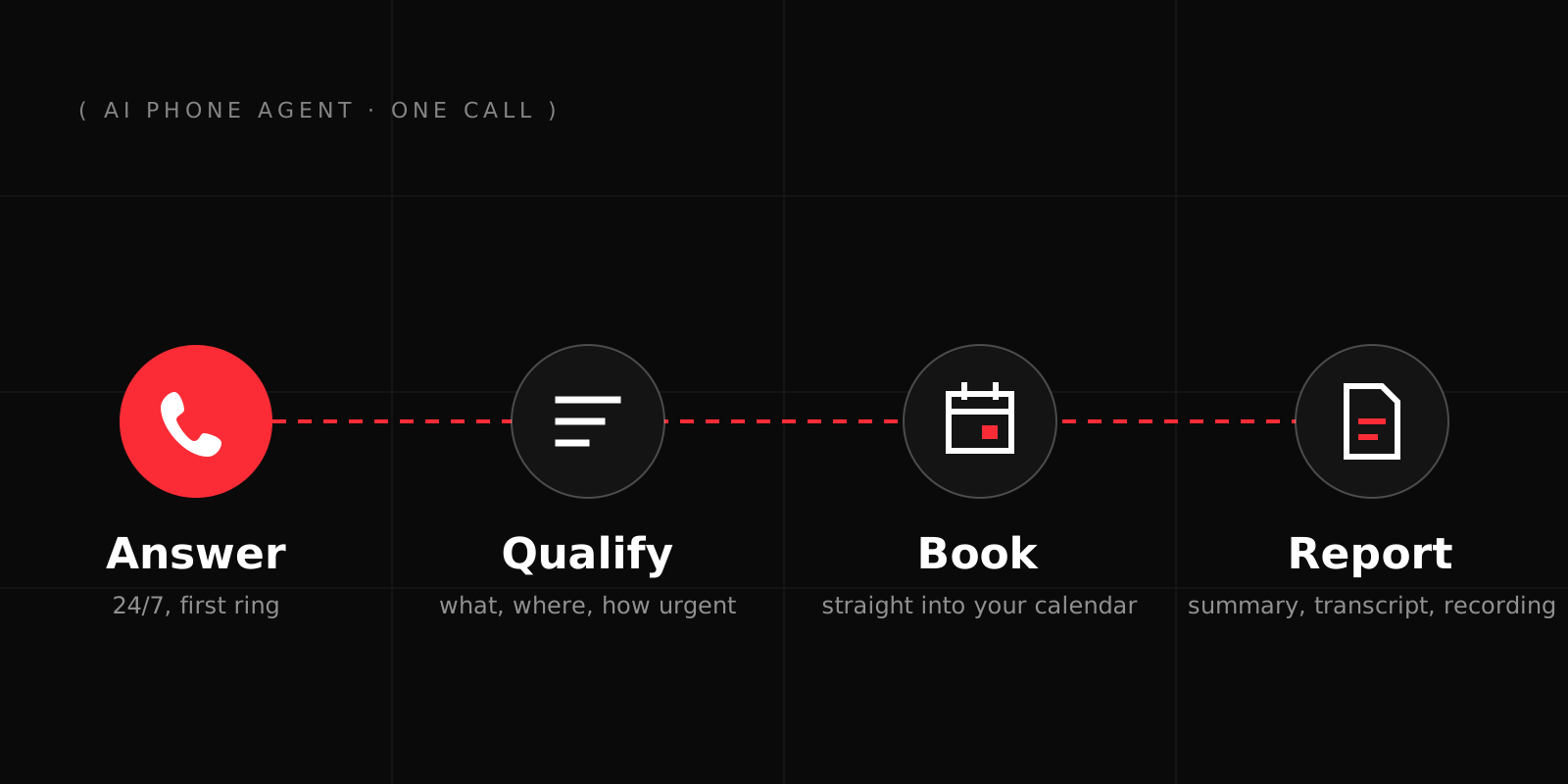
The four steps of a typical call
- Answer. The agent picks up on the first ring, day or night, with a greeting in your business's name.
- Qualify. It asks the questions your team would ask: what the problem is, where the job is, how urgent it is, and whether the caller is new or existing.
- Book. It offers open times from your real calendar and books the one the caller picks, so nothing has to be retyped later.
- Report. The team gets a summary, a transcript and a recording, so whoever follows up knows exactly what was said.
What it should not do
A well-built AI receptionist knows where its job ends. It should not give clinical advice to a patient, legal advice to a prospective client, or make dispatch decisions in an emergency. Those calls get handed to a person, and the agent says so plainly instead of guessing.
The real cost of missed calls
Missed calls are easy to ignore because they leave no trace. Nobody sees the customer who heard voicemail, hung up and booked with a competitor ten minutes later.
They cluster in predictable places:
- During the work itself. The technician is on a roof, the hygienist is with a patient, the mechanic has both hands in an engine.
- At peak times. Two calls arrive together and one of them waits, then gives up.
- Out of hours. Evenings and weekends are when many customers finally have time to call, and when nobody is there.
Returning those calls later helps, but only partly. By the time someone calls back, the customer may already have booked elsewhere, and the person returning calls is pulled away from paid work to do it.
AI phone agents vs. voicemail, an answering service or a receptionist
Each option solves part of the problem. The table compares them on the things that decide whether a caller becomes a booked job.
| Option | Answers 24/7 | Books into your calendar | Handles calls at the same time | Record of the call | Typical cost model |
|---|---|---|---|---|---|
| Voicemail | Takes a message | No | Yes | Audio message, if left | Free |
| Answering service | Usually | Rarely; takes a message | Limited by staff on shift | Written message | Per minute or per call |
| In-house receptionist | Business hours | Yes | One at a time | Whatever they note down | Salary and benefits |
| AI phone agent | Yes | Yes | Yes | Summary, transcript and recording | Monthly subscription or usage |
The pattern is clear. A front-desk hire is the best option during office hours if call volume justifies a full-time role. The AI option covers the gaps around them, or covers everything for a business that can't justify the hire. Voicemail and a message-taking answering service both leave the booking for later, which is where callers are lost.
When an AI receptionist pays off
You don't need an industry benchmark to decide. Your own phone records will tell you, and the arithmetic fits on the back of an envelope:
- Count missed calls. Pull a month of call logs from your phone provider and count calls that went unanswered or to voicemail.
- Estimate how many were real customers. Some will be spam or existing customers. Be conservative and keep only the share you believe were new work.
- Apply your close rate. Of the callers you do reach, how many book? Use that same rate.
- Multiply by job value. Use the average value of a first job, not a lifetime value, to keep the estimate honest.
If the result is comfortably above what the service costs per month, an AI receptionist is likely to pay for itself. If it is close, look at the time your team spends returning calls and copying details into the calendar; that time has a cost too.
Businesses that tend to benefit most
- Home services and HVAC, where the people who could answer are out on jobs.
- Clinics and dental practices, which get many new-patient calls and must keep clinical questions with staff.
- Auto shops and salons, where calls arrive while hands are busy.
- Law firms, which need intake details from every caller without any legal advice given.
How to set up an AI phone agent
Setup is mostly about telling the agent what your best receptionist already knows. Expect to work through these steps:
- Write down the common questions. Hours, service area, prices you are happy to quote, what to bring, how to prepare.
- Connect your calendar. The agent needs to see real availability and the length of each appointment type. Our own product, Voxipo, books into Google Calendar, Outlook, Cal.com, Calendly and Jobber.
- Set the hand-off rules. Decide which calls must reach a person and how: a transfer, a text to the owner, or an urgent flag on the summary.
- Decide on callbacks. If the agent will call back missed customers, it should call from your verified business number so customers recognize it.
- Test with real scenarios. Call it yourself with the awkward cases: the angry customer, the caller who wants a price you won't quote, the emergency.
A note on outbound calls and consent
Callbacks are outbound calls, and in the US they fall under telemarketing and robocall rules. In February 2024 the FCC confirmed that AI-generated voices count as "artificial" voices under the TCPA, so the same consent rules apply to them as to prerecorded calls. Calling back someone who just called you is a very different situation from cold calling, but the details matter, so check the FCC's declaratory ruling and ask your own counsel before turning callbacks on.
Start with the calls you already miss
Answering every call is not about replacing the people who know your customers. They make sure every caller reaches someone, at any hour, and that the booking lands in your calendar while the customer is still on the line.
The best place to start is your own call log. If a month of missed calls adds up to more than the service would cost, the case makes itself. Read more about what our AI phone agents do, or, if your bottleneck sits somewhere else, see the business automation we build around the tools you already use.
Want to know what your missed calls are worth? Email [email protected] with a rough monthly call count and we'll help you run the numbers.
Frequently asked questions
Will callers know they are talking to an AI?
They should. A good AI receptionist sounds natural, but it should not pretend to be a person. Being upfront is better for trust, and it keeps the conversation focused on getting the caller booked.
Can an AI phone agent transfer a call to a person?
Yes. You decide which calls must reach your team, such as emergencies or existing clients with an open job, and how they get there: a live transfer, an urgent text or a flagged summary.
How is an AI receptionist different from an answering service?
An answering service usually takes a message for someone to act on later. An AI receptionist answers, qualifies and books the appointment during the call, and leaves a summary, transcript and recording for the team.
How long does it take to set up?
Most of the work is writing down what your team already knows: common questions, services, hours and hand-off rules, then connecting your calendar. A simple setup can be live quickly, and it improves as you review real calls.